Showing posts with label Friday. Show all posts

Friday, 10 August 2018

Week 12: Forefront Friday: S.O.N

S.O.N is an independently financed horror game that began development in 2015 by a single developer. I find S.O.N very intriguing because the game seems to be played through the lens of a VHS camera, which I think is an interesting take on the “found footage” horror trope that I haven’t seen done anywhere else.

I place this game at the forefront of the industry because this is such a unique concept and challenges how I think I am perceiving what I am seeing. In a way we are not playing the game but watching old footage of someone exploring the house. It’s a very Meta concept and makes for a lot of interesting questions about how we are perceiving what we are playing.

In relation to my major project, I think this games aesthetics are reflective of what I have been aiming to achieve. It’s taking a relatively mundane setting and turning it into something foreboding and sinister. I especially enjoy the camera static as I feel this is another relatively harmless thing being turned into something menacing as the creatures approach the camera. As the game is being developed by a small team I will be watching this games performance with interest.

Gameplay trailer for S.O.N.

With the cancellation of Silent Hills by Hideo Kojima, I think people are still waiting for the next great horror title to fill the void. I would be very impressed if the small team at RedG studios are able to do so, as this shows you don't always need the biggest budget to be successful.

PLAYSTATION (2018) S.O.N – Official Gameplay Trailer #2 | PS4 [Online Video]. July 22nd. Available from: https://www.youtube.com/watch?v=oPZElemPUmE [Accessed: 10/08/2018].

REDG STUDIOS (TBA) S.O.N. [DISC, DOWNLOAD] Playstation 4. San Mateo: Sony Interactive Entertainment.

Friday, 3 August 2018

Week 11 - Forefront Friday: Promotional Video Research

In preparation for next week I have been looking at promotional videos of real time game environments created by other artists, so that I can examine them and make my video stand out. To clarify, I am not looking at game trailers but videos designed to showcase an environment within a game. I have chosen these examples because they are all recent and were posted within a few months of each other, making them a good indicator of the competition I am facing as I publish my work onto the internet.

I would say that not all of these videos are at the forefront. I believe they are mainly adhering to an established standard for showing off game environments. I think that being aware of what is expected from the industry is a crucial skill and I want to make sure that my work is conforming to this standard.

Rob Linssen:
 "Válenfall" - 7 days Ago


This is a stylised environment showing off the large scale of the location. Lots of sweeping shots give it a good sense of scale.

Joseph Armour:
"The Pale Elk" - 2 Months Ago

https://vimeo.com/274110496

This is a more kinetic video with some movement within the shots. My own video will most likely be much slower paced with less animation.

Emma Drew:
"Abandoned study" - 3 Months Ago

https://vimeo.com/269523304

This is an interesting project for me because it is similar in theme to what I am going for. I like to see how others have executed the same concept. She has shown off a lot of the foliage in this video which is something I want to do as well.


Vistorovschi Victor:
"Torrens Gallery" - 6 Months Ago


This video is really professionally made. The editing is very well paced and does an excellent job showing off the environments details.

My thoughts on these examples:

I have tried to select a range of artists across different skill levels. Whilst the quality of the videos may vary, all of these environments have let the visuals do the talking. I will be choosing to do this for my promotional video as well because I feel that if I try to explain my project it will come off as looking amateurish in comparison. Besides that, one of the primary objectives of my project was to tell a story through visual means. It would be antithetical to my goals to explain the plot and concept when I have intentional left those as a mystery for people to solve.

One thing I have noticed is that music they have chosen is very understated and in some cases is mostly ambient noise. I think this is a good idea because the visuals are the focus. I have a particular song in mind that should enchance the mood I am wanting to create and not compete with the environment itself.

Shot Inspiration:

I have also looked at this video of the Winchester mystery house because I feel it has some eerie shots that will lend themselves well to my environment:

A promotional video of the Winchester mystery house.

ARMOUR, J. (2018) The Pale Elk. [Online Video]. June 8th. Available from: https://vimeo.com/274110496 [Accessed: 03/08/2018].

DREW, E. (2018) Abandoned Study. [Online Video]. May 13th. Available from: https://vimeo.com/269523304 [Accessed: 03/08/2018].

HKDEUS (2018) Torrens Galley. [Online Video]. January 27th. Available from: https://www.youtube.com/watch?v=XIeohE6i0h0 [Accessed: 03/08/2018].
 
HOUZZ TV (2018) Winchester Mystery House POV Fly Through. [Online Video]. February 3rd. Available from: https://www.youtube.com/watch?v=3S5505SeNLA [Accessed: 03/08/2018].

PROJECT R0LIN (2018)"Válenfall" - Stylized Environment Flythrough. [Online Video]. August 1st. Available from: https://www.youtube.com/watch?v=26jUcpYosBw [Accessed: 03/08/2018].

Friday, 27 July 2018

Week 10 - Forefront Friday: The Artwork of Walid K-Perrussel

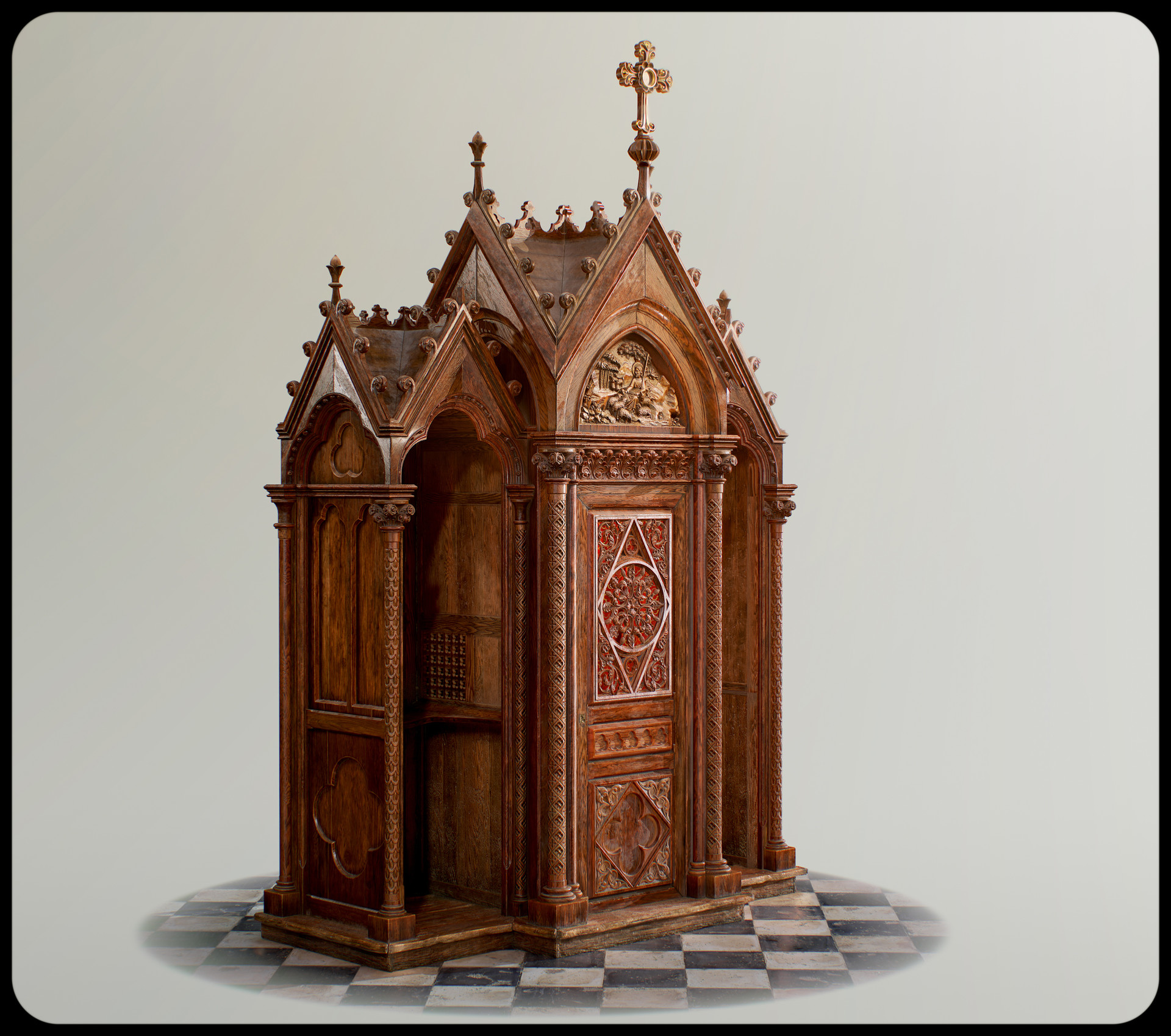
This week I have been studying the artwork of environment and prop artist Walid K-Perrussel. I was browsing Artstation looking for inspiration when his highly detailed model of a gothic confessional caught my attention.

https://cdna.artstation.com/p/assets/images/images/011/732/852/large/walid-k-perrussel-theconfessionnal-full.jpg?1531132821
K-PERRUSSEL, W. (2018), Gothic Confessional. [Online Image]. Available at: https://www.artstation.com/artwork/Jxz6R [Accessed: 27/07/2018].

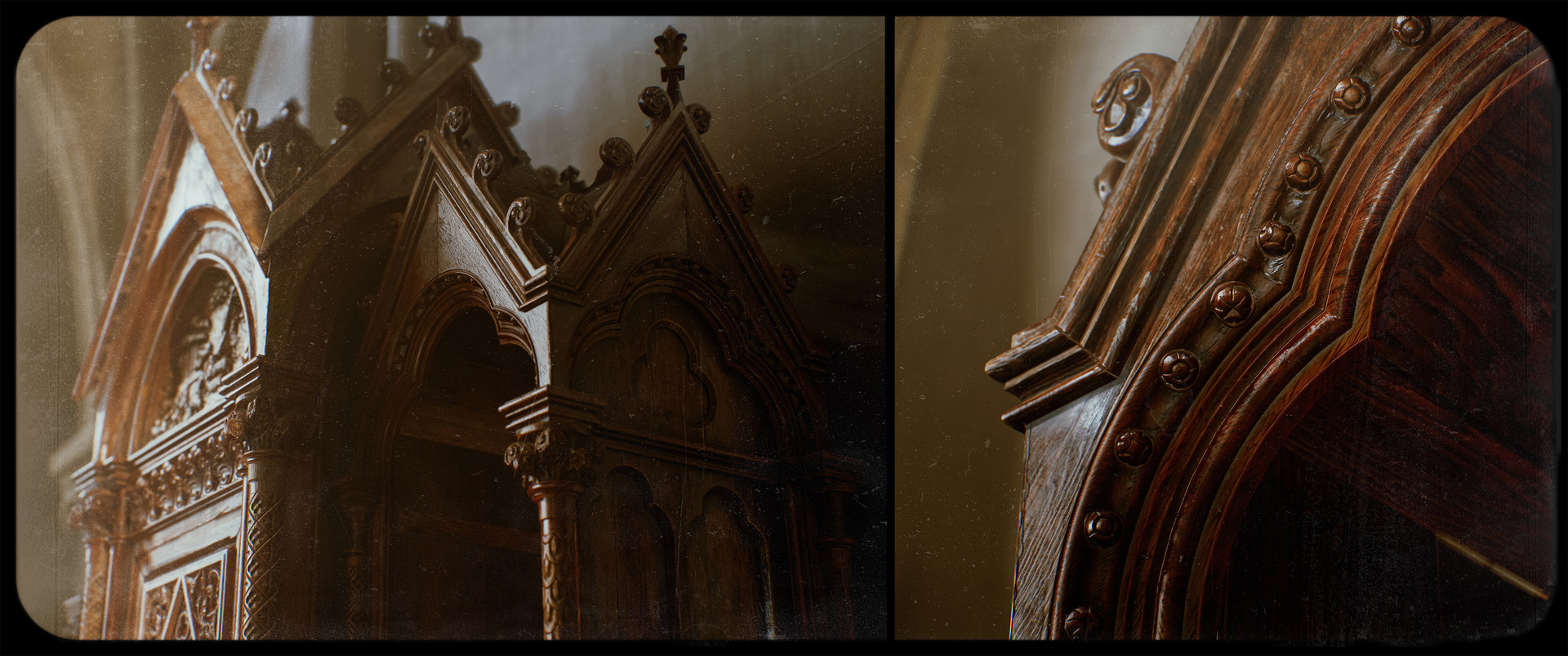
I identify this piece of art at the forefront of the industry because Walid has employed an array of the best tools used for texture creation to achieve a level of quality and realism with this asset. Walid has stated that he used a combination of Substance Designer and Painter as well as Megascans to create the wood textures for the model. The results are incredibly realistic and as someone who has been trying to create similar wood carved assets for my major project, I can see the obvious difference in quality between us as artists.

https://cdna.artstation.com/p/assets/images/images/011/738/262/large/walid-k-perrussel-theconfessionnal-angle-2.jpg?1531154486
K-PERRUSSEL, W. (2018), Gothic Confessional. [Online Image]. Available at: https://www.artstation.com/artwork/Jxz6R [Accessed: 27/07/2018].

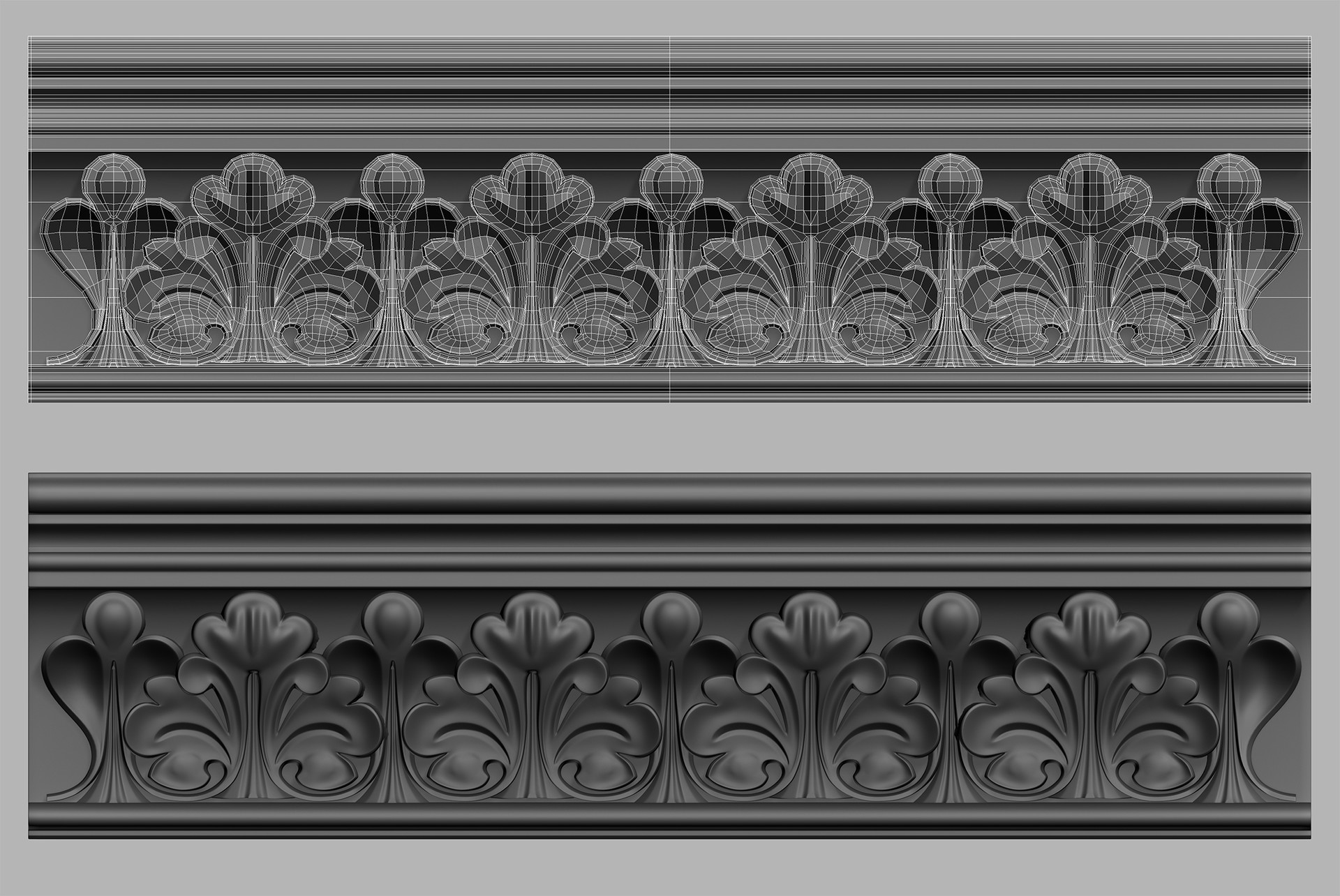
One thing that I found interesting, was that Walid had used 3DS Max to create the ornate high poly details of the model, as opposed to sculpting them in ZBrush. This is reassuring information to me as I create my high poly details in much the same way, by subdividing the geometry and adding smooth modifiers to them in 3DS Max. I have often worried that if I didn't use ZBrush to create high poly detail then I would be less competitive from an employability standpoint. It's a relief to know that using Max as an alternative is still viable amongst professionals.

 https://cdnb.artstation.com/p/assets/images/images/011/741/289/large/walid-k-perrussel-ornement-trimt.jpg?1531166706
K-PERRUSSEL, W. (2018), Sub-D Ornate: Gothic Confessional. [Online Image]. Available at: https://www.artstation.com/artwork/Jxz6R [Accessed: 27/07/2018].

This piece was a bit of an eye opener for me because the texture work Walid has displayed looks so realistic. The wood grain in particular is very life like when compared to the wood texture I made using Substance Painter. I would like to start investing time into learning to use Megascans, as it is clear that it produces photo-realistic results.

Friday, 20 July 2018

Week 9 - Forefront Friday: Star Wars Battlefront (2015)

I am planning to include a lot of foliage and vegetation growing inside of my mansion environment to emphasize how much time has passed since people actually lived there. This will mean that I need to create some unique assets myself as nothing within the demo pack will help with this.

Before creating my own vegetation I have decided to research some examples at the forefront to better understand how the games industry approaches realistic vegetation.

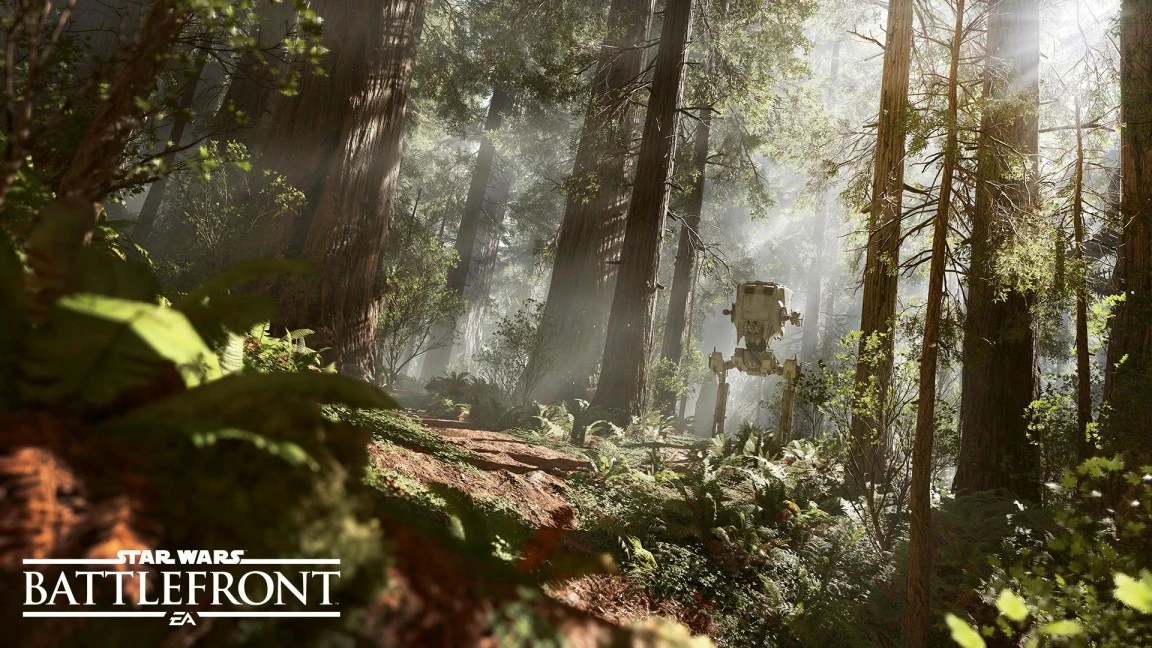
One game that has used photorealism to great effect is DICE Studios and EA Games “Star Wars Battlefront” (2015). Whilst the game itself has been the target of much criticism due to EA’s business practices, few could argue that the games graphics are incredible.

The planet Endor recreated in Star Wars Battlefront 2015.

I consider Star Wars Battlefront (2015) to be at the forefront of the industry because of the level of consideration that has gone into recreating the iconic environments from the films, and the detailed processes DICE have employed to create photo-realistic terrain.

The team at DICE would shoot photos on-location and plan their trips using a breakdown beforehand so they knew which assets needed to be captured during that shooting session. An article from website 3D Scan Expert states that the team put in a lot of effort to ensure that these photo shoots were efficient, because with Photogrammerty often times people end up shooting either too many or too few photos. Below you can see an example of the breakdowns the team would use when going on a photo shoot.

https://3dscanexpert.com/wp-content/uploads/star-wars-battlefront-3d-scanning-elements-768x432.png
An example of the breakdowns DICE Studios used to help organise their photo sessions.

The massive amount of photos were then taken and turned into usable game assets. The team would go through more of less the same phases as they would if they were creating the vegetation in a traditional way but in a quicker time frame. Below you see a comparison between the estimated time to create an asset for an earlier game (Battlefield 4) that used traditional methods and the Photogrammetry pipeline used Star Wars Battlefront. Compare the lengthy time for high poly modelling in a traditional way compared to creating the asset via photo scanning.

star-wars-battlefront-3d-scanning-time
A comparisson of the time required to create an asset with Photogrammetry versus traditional methodology

It is quite clear that DICE have put in great effort into planning the creation of vegetation for their game. My project plan mainly factored in hard surface modelling and texture creation. I did leave myself a small window to create organic assets but it is clear that such a small window will not yield results anywhere near as impressive as Star Wars Battlefront.

This is not a huge issue for me as I am not focused on becoming an organic modeler for my career. Therefore I don’t wish to spend too much time creating detailed vegetation. Photogrammetry definitely seems like the best option for realistic vegetation and foliage due to the near perfect replicas it produces. Because of this, the ability to create detailed vegetation from scratch may not be the most sought skill in the industry at the moment.

Because I don’t have the resources available to create realistic photo scanned models, one option may be for me to download another asset pack from the Unreal Engine marketplace, one that is well suited to create indoor vegetation. I have already saved time on assets such as trees and grass on the exterior sections of my environment, however I am still interested in creating individual pieces such as ivy and weeds myself. Because I want them to conform to the shape of my building perfectly, this is something that I feel I will have better control over if I create them myself.

Ultimately I feel a blending of both my own and professionally made assets will be the best course. I have already made use of the Unreal Engine marketplace, so by studying the assets available I will be able to see how they were created and apply this knowledge to my own work.

DICE. (2015) Star Wars Battlefront. [DISC, DOWNLOAD] Microsoft Windows, PlayStation 4, Xbox One. Redwood City: Electronic Arts.

DICE. (2015), EndorDICE. [Online Image]. Available at: https://vignette.wikia.nocookie.net/battlefront/images/8/81/EndorDICE.jpg/revision/latest?cb=20151111221829 [Accessed: 20/07/2018].

DICE. (2015), PhotoBreakdown. [Online Image]. Available at: https://3dscanexpert.com/wp-content/uploads/star-wars-battlefront-3d-scanning-elements-768x432.png [Accessed: 20/07/2018].

GAMASUTA. (2016) GDC: See how DICE used photogrammetry to bring Star Wars Battlefront to life . [Online] Available from: https://www.gamasutra.com/view/news/265747/GDC_See_how_DICE_used_photogrammetry_to_bring_Star_Wars_Battlefront_to_life.php [Accessed: 20/07/2018]  

LIEVENDAG, N. (2016) How 3D Scanning was used to create the worlds of Star Wars Battlefront. [Online] Available from: https://3dscanexpert.com/3d-scanning-star-wars-battlefront/ [Accessed: 20/07/2018]  

Friday, 13 July 2018

Week 8 - Forefront Friday: Horizon Zero Dawn (2015)

I am at the end of week eight of my major project development. This leaves me with just three weeks remaining to finish my environment. I believe I will be able to complete this project on schedule and as such I am going to be sticking very closely to the final weeks of my project plan.

 Entering the final four weeks of my project development.

Before I start next week I have been researching games that I feel have particularly strong environment design. Horizon Zero Dawn (2017) is game that features a post-apocalyptic world that is slowly being enveloped by nature. I love the juxtaposition of nature and technology and I think this has given the game incredibly strong visuals.

Horizon Zero Dawn trailer.

I place this game at the forefront of the industry because it offers a fully open world similar to the Legend of Zelda: Breath of the Wild (2017). Unlike Zelda however, this game has a far more realistic graphical style which makes the fact that it can display all those assets on screen at once very impressive.

I have been drawing inspiration from the Game's foliage and vegetation that is growing everywhere in the world and ensnaring old structures. I want my environment to have a similar feel, in that nature is beginning to take its course and overtake the mansion.

Over the next few weeks I am going to be experimenting with creating my own foliage and using it within Unreal Engine. I feel this is perhaps one of the most important elements that will be within my environment, as realistic feeling vegetation will make my project far more believable. I am making references of how Horizon Zero Dawn has used particular types of vegetation that I think will be effective in my scene. So far I am interested in creating ivy because I like how it conforms to the shape of buildings and isn't placed randomly.

GUERRILLA GAMES (2017) Horizon Zero Dawn. [DISC, DOWNLOAD] Playstation 4. San Mateo: Sony Interactive Entertainment. 

PLAYSTATION (2015) Horizon Zero Dawn - E3 2015 Trailer | PS4. [Online Video]. June 15th. Available from: https://www.youtube.com/watch?v=Fkg5UVTsKCE [Accessed: 13/07/2018].

Friday, 6 July 2018

Week 7 - Forefront Friday: Death Stranding

Death Stranding (TBA) is an upcoming video game that was first revealed at E3 in 2016. I cite this as an example of the forefront because of its prioritisation of narrative over gameplay in a climate where story driven games are being seen as less viable by larger game studios such as EA games for example.

Death Stranding is a unique case because it has generated an enormous amount of interest without revealing any information about how it will actually play. Because of this, I feel it serves as a great example of video games subverting the medium and challenging what we expect from them. With the casting of high profile actor Norman Reedus as the leading role, I believe Death Stranding is blurring the lines between video games and film. When asked whether there would be a blending between the two mediums, the games director Hideo Kojima responded:

“The process is almost the same. The only difference nowadays is if they are interactive or not. When it comes to the fact of controlling, being able to adjust the camera, I think that will keep changing and this will be an element that will increasingly be combined and maybe the line between these two mediums will disappear.”

Kojima is somewhat infamous for having lengthy cutscenes in his games and I am expecting Death Stranding to be no exception. However it looks like this game will be pushing the boundaries as to what it means to be a cinematic gaming experience. The emphasis on narrative could mean that the game will be unlike anything ever released. Either way I find this to be a very interesting title that could catch the attention of filmmakers eager to experiment with the way visual stories are told.

In terms of my major project development, I am eager to place an emphasis on the story aspect of my game environment, as I believe my skills as an artist will reflect how clearly the story is conveyed through the imagery. If Death Stranding proves to be successful there could be a greater demand for story driven games and my focus as an artist could be directed towards creating similar projects.

KOJIMA PRODUCTIONS (TBA) Death Stranding. [DISC, DOWNLOAD] Playstation 4. San Mateo: Sony Interactive Entertainment.

MAKUCH, P. (2017) EA Talks About Closing Visceral And Single-Player Games. [Online] Available from: https://www.gamespot.com/articles/ea-talks-about-closing-visceral-and-single-player-/1100-6454535/ [Accessed: 14/06/2018]

SHANLEY, P. (2018) 'Death Stranding': Hideo Kojima on Taking a "Different Approach to Single-Player Games" [Online] Available from: https://www.hollywoodreporter.com/heat-vision/death-stranding-hideo-kojima-casting-lea-seydoux-lindsay-wagner-1119548 [Accessed: 14/06/2018]

Friday, 29 June 2018

Week 6 - Forefront Friday: Xbox and Nintendo Switch Crossplay

For the first time Nintendo and Microsoft, two of the world’s leading video game companies are working together to bring cross-console compatibility to their games. Minecraft (2011) has become one of the industry's first fully cross platform games. Gamers from Xbox, PC, Smart Phone and Nintendo Switch can now play the game together regardless of which console they are using. 

The Minecraft cross-play trailer for the Nintendo Switch.

It was somewhat surreal for me watching the announcement from Nintendo and seeing an Xbox controller in the trailer. It is particularly interesting that the two rival companies Microsoft and Nintendo are now openly advertising for each other's game system. I feel this is a red letter moment in the history of the gaming industry because it feels like this is very much a pro consumer approach. 

I believe cross platform gaming is at the forefront of innovation within the gaming industry. Now that mainstream games are becoming compatible across multiple systems, I could be starting my career as a games artists at the beginning of a new paradigm in the industry. One that requires the game art to be optimised for use across a variety of different game system architecture. This could mean that the practices employed across the industry become increasingly unified, to help games have better compatibility with one another.

I believe it will be crucial in the coming months to monitor current industry practice and adhere to these design concepts in my own work in order to remain competitive within these new business practices.

GORDON, R. (2018) Microsoft & Nintendo Emphasize Minecraft Cross-Play Together While PlayStation Sits By Itself. [Online] Available from: https://screenrant.com/minecraft-microsoft-nintendo-cross-play/ [Accessed: 29th June 2018].

NINTENDO (2018) Minecraft Cross-Play Trailer - Nintendo Switch. [Online Video]. June 21st. Available from: https://www.youtube.com/watch?v=0l8nJ_liqrw. [Accessed: June 29th 2018].

Friday, 22 June 2018

Week 5 - Forefront Friday: Visage

Visage (TBA) is an upcoming independent survival horror game and looks to be a spiritual successor to Hideo Kojima's P.T. (2014). It is a noteworthy example of a high quality game funded entirely through Kickstarter. I cite this as an example of the forefront because it is pushing the genre of atmospheric horror to new heights. It accomplishes this mainly through its visual juxtaposition of an idyllic urban household mixed with otherworldly imagery and horror. The games sound design is entirely atmospheric and it is setup in a way that it gives hints and clues to alert the players about the dangers lurking in the house.

Gameplay trailer for Visage.

I find this to be a particularly exciting game because the developers are intending every play through to be a unique experience. The events in Visage will be randomly activated throughout each play session, with the player’s choices resulting in different endings. Visage will also be supporting virtual reality and looks to be a terrifying front runner in advancing psychological horror in video games.

The game is being made in Unreal Engine 4 and as such I will be interested to see how far the team at SadSquare Studio are able to take the game's psychedelic visuals. Originally I wanted to employ similar visual tricks in my major project environment but because I am less focused on gameplay at the moment, I will most likely not incorporate them at this stage. However for my final trailer I would like to experiment with some of the effects they have used as I feel this trailer sets a very ominous tone and I would like to replicate this in my promotional video.

7780'S STUDIO. (2014) P.T.. [DOWNLOAD] PlayStation 4. Tokyo: Konami.

GAME TRAILERS (2017) Visage - Official Gameplay Trailer. [Online Video]. June 22nd. Available from: https://www.youtube.com/watch?v=l1sOQcHYwE4. [Accessed: 22/06/2018].

SADSQUARE STUDIO. (TBA) Visage. [DISC, DOWNLOAD] Microsoft Windows, PlayStation 4, Xbox One. SadSquare Studio.

Friday, 15 June 2018

Week 4 - Forefront Friday: Photogrammetry and Realism in Games


Photogrammetry is the process of pulling visual data from an array of photographs for the purpose of generating fully textured high poly models. Recently this process has begun to be seen within video games with EA’s Star Wars: Battlefront series being a stellar example of the stunning graphics achievable with this technique.

I found an interesting article from Indie game developer Andrzej Poznanski, who talked in length about how his team utilised photogrammetry techniques to create the visuals for their game The Vanishing of Ethan Carter (2014). Whilst this is not a new game Andrzej highlighted something that I felt was pertinent in regards to my approach as an environment artist.

As Andrzej points out, the thing that really set their Photogrammetry assets apart from traditional methods was the logical way the textures had been broken up. Repetitive tiling and texture seams are not obvious and whilst it is possible to disguise these without photogrammetry, the variation that comes through real photos are not randomised. They have a logical reason for looking the way they do scuffs for example aren’t added without thought, they appear where they would logically. As he puts it: 

The floor might be more worn out around the front door, or where your chair wheels constantly scrub a patch of the floor, and the outer wall might be darker from the side that gets hit by the rain more often, etc. … Like in video games. Even if on the unconscious level, your brain points out to you all those perfectly tiling textures, all those evenly worn-out surfaces, those stains placed in all the wrong places – and whispers in your ear: LOL!” 

This is something that I have often struggled with doing correctly. I have been aware that I needed to add texture variation to my environment however I am guilty of doing this randomly. You can see this in my Hangar Bay environment below, where I added dirt to random locations to try and break up the texture:


From here on I intend to pay close attention to details and recreate them sensibly in my scene. I feel this will be a subtle but important contribution to making my environments feel real. Of course I can’t contend with real world scanned textures created through photogrammetry, however I feel at least I can adopt a logical approach as Andrezj says and really emulate details in the proper locations whereas before I was doing this without thinking.

DICE. (2015) Star Wars Battlefront. [DISC, DOWNLOAD] Microsoft Windows, PlayStation 4, Xbox One. Redwood City: Electronic Arts.

POZNANSKI, A. (2014) Visual Revolution of the Vanishing of Ethan Carter. [Online] Available from: http://www.theastronauts.com/2014/03/visual-revolution-vanishing-ethan-carter/ [Accessed: 15/06/2018] 

RUSH, J. (2018) Photogrammetry for Games. [Online] Available from: http://www.cgsociety.org/training/course/photogrammetry-for-games [Accessed: 15/06/2018]

Friday, 8 June 2018

Week 3 - Forefront Friday: The Artwork of Jonas Ronnegard

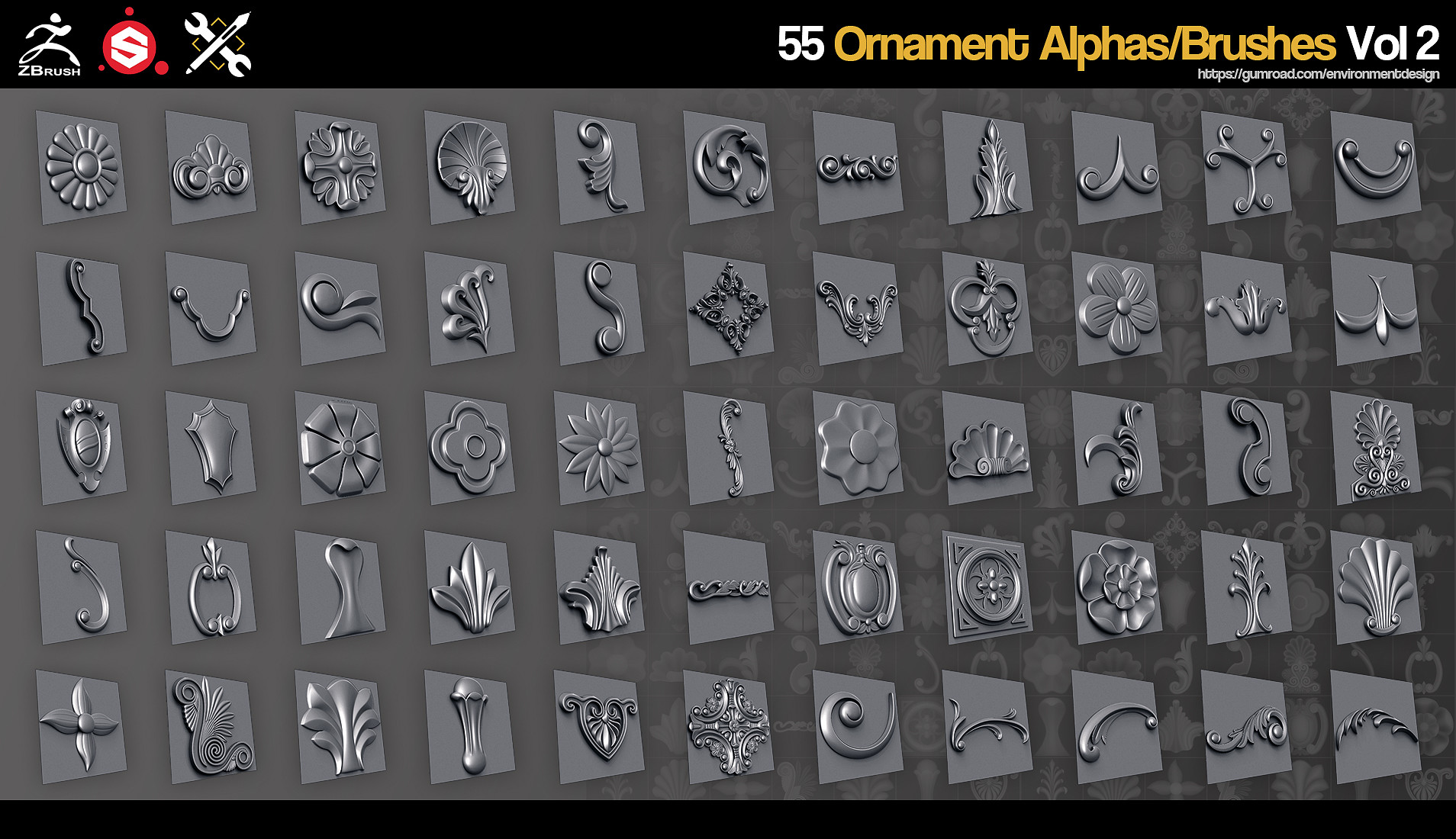
Jonas Ronnegard is a freelance environment artist who has built an arsenal of tools and resources for other artists to purchase. I was very impressed with his portfolio on Artstation and one video in particular, where he demonstrates the effectiveness of his ornamental brushes in ZBrush made my jaw drop. 

You can watch the video here at: https://www.youtube.com/watch?time_continue=119&v=dNUHjB4YK5c

https://cdnb.artstation.com/p/assets/images/images/007/197/755/large/jonas-ronnegard-main03.jpg?1504387560
A selection of the alpha brushes that Jonas has created.

This is honestly why I need to start using ZBrush as Jonas showcases with ease how quickly he was able to create ornate details and then texture them in Substance Painter. When it comes to my own workflow I spend a lot of time carefully positioning details within 3DS Max and then exporting them for hard surface transfer. Whilst I feel I have gotten the workflow down, when compared to the cutting edge brush details created by Jonas, I obviously could be a lot faster in this area. For me this seems the quickest way to simulate details because when I start to use a lot of high poly models in my 3D scenes the computer performance starts to struggle. This is a problem not present in ZBrush as the software can display an incredibly high amount of polygons without performance loss.

Studying Ronnegard's portfolio I can already see areas that I need to improve in such as organic modeling. As an environment artist I need to make sure I am capable of both hard surface and natural details. Currently my portfolio leans very heavily toward architectural models and if I am to reach the high standards set by Jonas Ronnegard, I will need to prove that I can diversify whilst retaining a consistent quality throughout my work.

RONNEGARD, J. (2017). JRO - 55 Ornament Brushes/Alphas Vol 2. [Online Image] Available at: https://www.artstation.com/artwork/5ggxA [Accessed 08/06/2018].

JROTOOLS. (2017) Ornament Alphas/Brushes Vol 2 - Preview. [Online Video] September 5th. Available from: https://www.youtube.com/watch?time_continue=119&v=dNUHjB4YK5c [Accessed: 08/06/2018]

Friday, 1 June 2018

Week 2 - Forefront Friday: Scorn

Scorn (2018) Scorn is an upcoming first-person shooter horror game set to be released this October. The game features striking visual designs inspired by the work of H.R Giger. I find this game to be an interesting example of the forefront because it is a modern take on an artist's work that has influenced a lot of iconic games over the past few decades. I find it particularly interesting to see how this art style has been translated to the high fidelity 3D environments seen in Scorn.

 An early trailer for the game Scorn.

Dark Seed is a game from the early 1990's with a surrealistic art syle based on H.R. Giger's artwork. It is exciting for me to see how Scorn has been inspired by the same artist and brought this visual style into the modern technological age, allowing for fully interactive 3D alien landscapes.

https://proxy.duckduckgo.com/iu/?u=https%3A%2F%2Fwww.myabandonware.com%2Fmedia%2Fscreenshots%2Fd%2Fdark-seed-1dl%2Fdark-seed_14.png&f=1
A screenshot from the 1992 game Darkseed. The game features environments based on the work of H.R. Giger.

The developers have claimed they have designed the game around the idea of "being thrown into the world", and as such, very little context is given about the game's setting. This is an element that I love in video games, as ambiquity and trying to decipher the story for yourself is a big draw for me and is something I wish to include in my own work.

The developers have explained that they want to make the unsettling environment feel like a character in itself and this is an amazing concept that lends itself to a lot of creative visual storytelling. I want my own environment to almost take on a life of its own. As the player explores deeper into the mansion's dark halls, I want it to feel like they are slowly being swallowed by the monstrous structure.

CYBERDREAMS (1992) Dark Seed. [DISC] Amiga, MS-DOS, Amiga CD32, Macintosh, Sega Saturn, PlayStation. Calabasas: Cyberdreams.

EBB SOFTWARE (2018) Scorn - Part 1 of 2: Dasein. [DOWNLOAD] Microsoft Windows. San Francisco: Humble Bundle.

GAME NEWS OFFICIAL (2016) SCORN Official Trailer (2017). [Online Video]. July 9th. Available from: https://www.youtube.com/watch?v=BKTkCa5nB_8 [Accessed: 01/06/2018].

VENTURES, E. (2017) Exclusive Interview with Lead Developer of Scorn. [Online] Available from: http://opiumpulses.com/article/189 [Accessed: 01/06/2018]

Friday, 25 May 2018

Week 1 - Forefront Friday: Unreal Engine 4

The forefront of the video game industry can be identified by an array of different artefacts, individuals and processes. I think a good indicator of the forefront is when a technique, process or piece of software changes the way practitioners within the industry create their games. I believe Unreal Engine 4 is one such piece of software.

Throughout this year I have been building my workflow around real time rendering through Unreal Engine 4. As an environment artist I consider this an essential piece of software because it is the primary method I use to display my art. Real time graphics have offered me a new way to interact with my work during production, giving me instant feedback to any creative changes I make meaning I no longer have to wait for a render to finish before I can see the final result of my work. It is largely for this reason that I believe Unreal Engine in particular is at the forefront of not just the games industry but across all areas of 3D visualisation.

Instead of a static image displayed on screen, Unreal Engine offers artists dynamic vantage points displayed in real time. If they find an issue they can then make changes immediately with instant feedback. This is great from a design perspective as artists no longer have to wait for hours at a time to get a new rendering of a proposed change. This emphasis on interaction has played a big part in design firms within the architectural sector turning to real-time technology for visual solutions. From the Unreal Engine blog, Ken Pimentel lists Italian architectural firm Lissoni Associates and Neoscape, a creative agency that focuses on design for real estate, as companies revolutionizing their design process through interactive real-time graphics powered by Unreal Engine. (Pimentel 2018).

Indeed, my main reason for choosing to study at the University of Hertfordshire was that my architecture company was looking to get into real time visualisation using Unreal Engine, and I felt that there was a lot I didn’t know about this field and I could see there were a lot of benefits to using real time rendering. Because of these Unreal Engine’s relevance at the forefront of the field of 3D visualisation is constantly increasing. It has shifted its identity away from being solely known as a tool for game development, to a legitimate means of producing high end visualisations for numerous industries ranging from film to architecture.

The droid from the film Star Wars: Rogue One (2017) was rendered in real time using Unreal Engine, a first for the industry. As real time graphics displays are making it easier for film makers and artists to receive instant feedback from creative decisions, costly render times are also being negated. This coupled with the Engine’s unbeatable price point of completely free, has solidified the software at the forefront of 3D visualisation.

I believe the adoption of Unreal Engine across the different industries of the creative economy is Marshall Mcluhan’s concept of the Global village in action. We are seeing the differences of software and terminology across distinct fields becoming smaller and smaller. This could ultimately change the way we perceive mediums such as film, games and architecture, especially when they are driven by the same technology and methodologies.

PIMENTEL, K. (2018) Moving Beyond the Image: Test Drive Your Visual Designs. [Online] Available at: https://www.unrealengine.com/en-US/blog/moving-beyond-the-image-test-drive-your-visual-designs [Accessed: 11/06/2018]

POLYGON. (2017). Star Wars: Rogue One’s best character was rendered in real time, a cinema first. Available at: https://www.polygon.com/2017/3/1/14777806/gdc-epic-rogue-one-star-wars-k2so [Accessed: 11/06/2018]